
Physics Professor Awarded NASA Research Grant
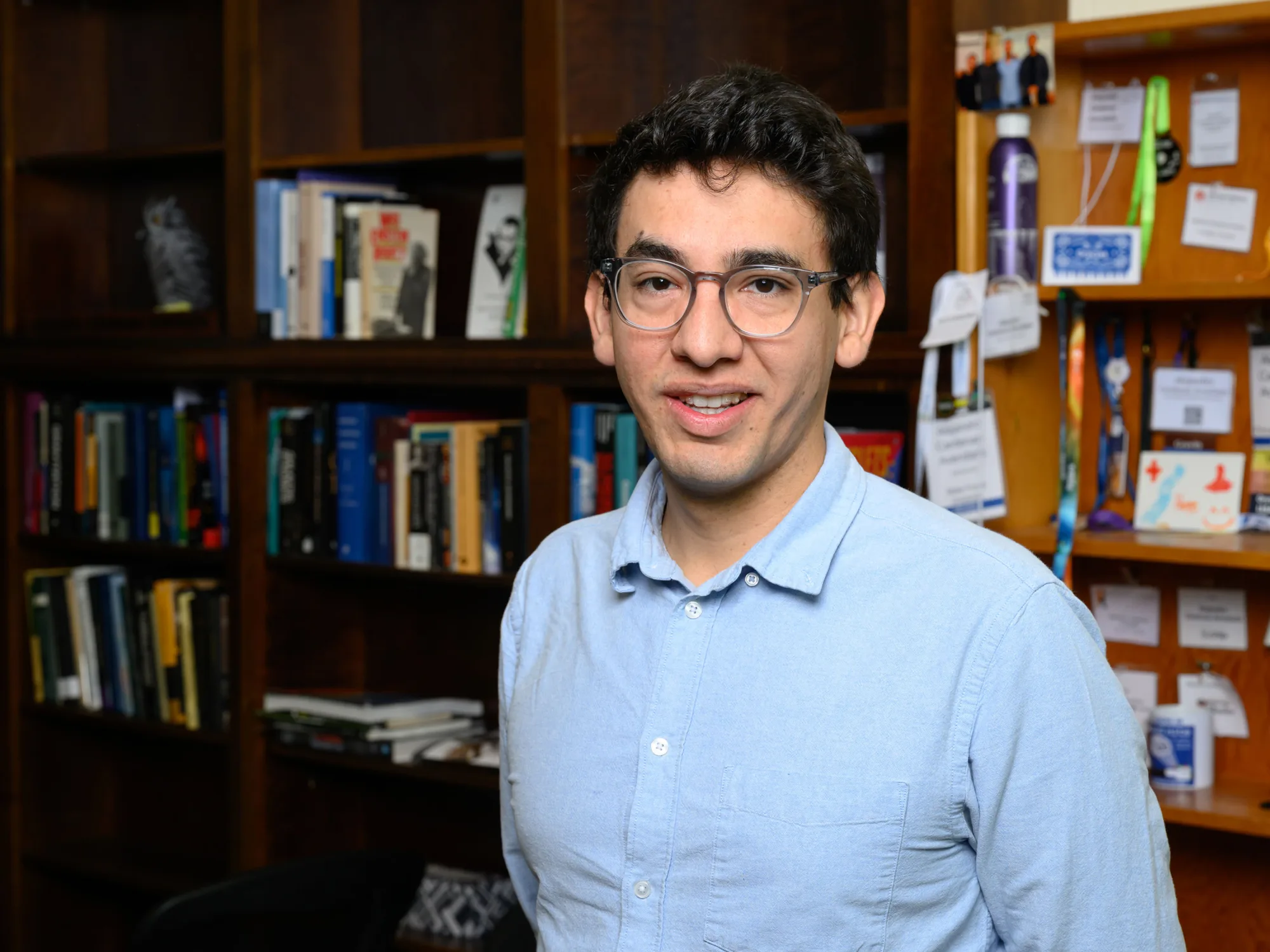
NASA has awarded Wake Forest University Assistant Professor of Physics Alejandro Cárdenas-Avendaño a two-year, $374,000 grant to advance data analysis capabilities for the anticipated launch of NASA’s Laser Interferometer Space Antenna (LISA) in 2035—the world’s first space-based gravitational wave observatory.
Detecting and analyzing gravitational waves offers a new window into observing and understanding our universe.
The grant will allow Wake Forest students to “serve as the primary drivers of the research, receiving hands-on mentorship,” said Cárdenas-Avendaño, adding that the funding will help support two full-time graduate students, Lennox Keeble and Edoardo Levati, and at least two summer undergraduate researchers. Cárdenas-Avendaño and his students will also have the opportunity to collaborate with NASA research astrophysicist Tyson Littenberg at the Marshall Space Flight Center in Huntsville, Alabama.
This grant is funded through Collaborative Opportunities for Mentorship, Partnership and Success in Science (COMPASS), which fosters collaboration between NASA and an academic institution to advance NASA scientific priorities and to train the future STEM workforce.
Cárdenas-Avendaño’s research will use machine learning and simulations to detect and characterize the gravitational waves created by the orbit of a small, compact object around a supermassive black hole, which is known as an extreme mass-ratio inspiral. These systems are usually found at the center of galaxies.
“With this grant, our task is to develop novel techniques, something that is called simulation-based inference…to detect these systems and characterize them,” Cárdenas-Avendaño said. The grant allows “Wake Forest and our students, my group, to collaborate with scientists at NASA towards the LISA mission, which is the future of millihertz gravitational waves.”